
Morpheus: A Categorical Programming Language for Deep Learning
A language where category theory is the type system — every program that type-checks is a structurally valid architecture, and the compiler can prove it in Lean 4.
In brief
Morpheus is a programming language where category theory is the type system: objects are tensor spaces, morphisms are parametric layers, and a layer that respects its data's structure is an algebra homomorphism the compiler can verify. Built on the categorical-deep-learning thesis that layers are algebra homomorphisms, a Morpheus program that type-checks is a structurally valid architecture by construction — and its Rust compiler can emit machine-checked Lean 4 proofs that it is.
Key results
- Every category-theoretic construct — object, morphism, functor, natural transformation, (co)monad, (co)algebra, adjunction, (co)limit, pullback — is a first-class Morpheus keyword with a precise deep-learning meaning.
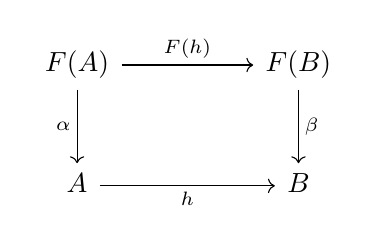
- A layer that respects its data's structure is an algebra homomorphism: the compiler checks the equivariance square h . alpha = beta . F(h), so a program that type-checks is a structurally valid architecture by construction.
- The Rust compiler lexes and parses into a categorical AST (a Statement enum whose variants are category theory), type-checks composition compatibility object-by-object, lowers to a Categorical IR, and emits PyTorch modules.
- An optional Lean 4 backend discharges categorical proof obligations (functor laws, algebra homomorphisms, monad laws); the implementation proves 11 Lean 4 theorems with zero sorry.
- The current implementation type-checks 27 of 29 conformance programs (2 expected failures), passes 20 of 20 test suites, and compiles 23 of 23 example models to native arm64 binaries.
- Worked examples span the categorical zoo: an image classifier over a grid endofunctor, a graph attention network, a VAE in the Kleisli category of a Gaussian monad, and an encoder-decoder adjunction.
Deep learning as algebra
Modern deep learning is practiced closer to alchemy than to engineering: layers are stacked by intuition, and a tensor framework reports a shape error only at runtime, if at all. There is no notion, at the level of the program, of whether a composition of layers is structurally meaningful — whether attention is a legitimate way to process set-structured data, or whether pooling commutes with the layers around it.
A recent line of applied category theory supplies the missing structure. The categorical-deep-learning program argues that a layer which respects the structure of its input is exactly a (lax) algebra homomorphism for the endofunctor that generates that structure: the square relating F(h), the structure map alpha, and the target structure map beta commutes, i.e. h . alpha = beta . F(h). In the vector-space category this unrolls into the familiar equivariance equation — processing then folding equals folding then processing — and recovers convolutions as translation-equivariant maps, while also generalizing to folds over lists, reductions over trees, and weight-tying across layers. Morpheus's thesis is that this analogy should be realized not as a library but as a language.
Category theory as keywords
Morpheus elevates each categorical construct to a first-class keyword, and the compiler's AST makes the correspondence exact: every variant of the top-level Statement enum is a category-theoretic construct — CategoryDecl, FunctorDef, EndofunctorDef, NaturalDef, MonadDef, AlgebraDef, AdjunctionDef, PullbackDef, LimitDef, ColimitDef, and SearchDef among them. Objects are tensor spaces (a shape together with the category it lives in); morphisms are parametric layers in Para(Vect); composition is a single operator.
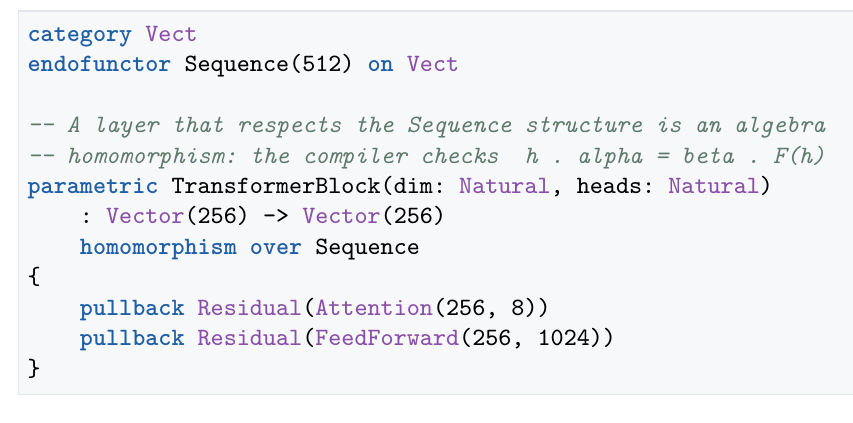
The language is designed to read like writing mathematics in a scripting language. The canonical construct is the algebra-homomorphism annotation on a layer, which carries a strictness (strict, lax, or oplax) and the name of the endofunctor whose structure the layer must respect — the heart of the language, and the point where an architectural guarantee becomes a type.
The compiler
The compiler is written in Rust. It lexes and parses the surface syntax into a categorical AST, type-checks composition compatibility object-by-object — the output object of f must match the input object of g before f ; g type-checks — lowers the diagram to a Categorical Intermediate Representation, and generates code for backends including PyTorch and native Rust. An optional verification mode emits proof obligations for the categorical laws (functor laws, algebra homomorphisms, monad laws) and discharges them in Lean 4 through a custom tactic.
The implementation is honest about its current reach. It type-checks 27 of 29 conformance programs (2 are expected failures), passes 20 of 20 test suites, compiles 23 of 23 example models to native arm64 binaries, and proves 11 Lean 4 theorems with zero sorry — a real but deliberately narrow foundation relative to the broader specification.

Worked architectures
Because the categorical vocabulary is general, the same grammar expresses architectures across data modalities by changing only the endofunctor: sequence modeling, image classification over a grid endofunctor, graph property prediction over a graph functor, point-cloud segmentation over a multiset, and multimodal fusion over a product of endofunctors. The example programs work through this zoo concretely.
Several examples are illuminating about the framing. A variational autoencoder is written in the Kleisli category of a Gaussian monad, so the stochastic sampling step is the monadic structure rather than an ad-hoc reparameterization. An encoder-decoder autoencoder is an adjunction, with the reconstruction loss minimizing the gap between the round-trip and the identity. Attention is read as a limit (a universal query-weighted aggregation) and pooling as a colimit; a residual connection is a pullback, the universal fork-then-merge.
What is proven, and what is not
The value of pushing architecture semantics into a type system is that whole classes of mistakes become compile-time theorems rather than silent runtime bugs, and the Lean 4 backend lets the strongest of those guarantees be machine-checked rather than merely asserted. That is the system's reason for being.
It is also candid about its sharp edges. Most pointedly, self-attention is not a strict fold homomorphism, and the type checker should reject annotating it as one — the honest consequence of taking the categorical semantics seriously rather than decoratively. The gap between what is implemented and what the broader specification describes is real, and the paper states it plainly: Morpheus is a research language under active development, not a finished compiler.
Abstract
Morpheus is a compiled, statically typed programming language in which category theory is the type system, and the type system is the architecture-constraint system. Motivated by the thesis that neural-network layers are (lax) algebra homomorphisms, Morpheus gives every categorical construct — object, morphism, functor, natural transformation, (co)monad, (co)algebra, adjunction, (co)limit, pullback — a concrete language keyword, and every keyword a precise deep-learning meaning. A Morpheus program is a commutative diagram: objects are tensor spaces, morphisms are parametric layers in Para(Vect), composition is the categorical composition operator, and an algebra-homomorphism annotation asks the compiler to verify the equivariance diagram h . alpha = beta . F(h). The compiler, written in Rust, lexes and parses the surface syntax into a categorical AST, type-checks composition compatibility object-by-object, lowers to a Categorical Intermediate Representation, and emits PyTorch modules, with an optional Lean 4 backend that discharges the categorical proof obligations. The central claim is that every program that type-checks is a structurally valid architecture, turning a large class of architectural mistakes from silent runtime bugs into compile-time theorems.